PREFACE
The Call for a New World Almanac
In every era, humanity has searched for wisdom through different doors.
Some entered through science, seeking precision and proof.
Some entered through philosophy, seeking meaning and coherence.
Some entered through spirituality, seeking unity and transcendence.
Some entered through lived experience, seeking survival, dignity, and truth.
Yet despite the diversity of these pathways, all seekers eventually discovered the same pattern:
Every journey, no matter how complex, returns to a single point of origin.
This point, the irreducible foundation beneath all systems of thought is what The New World Almanac names Zero Ground.
Myrna D. Santos, MSN, PHN, RN
Founder, Principal
The Call for a New World Almanac in Public Health
PREFACE: The Doctrine of the Open Table of Contents
The Table of Contents of The Call for a New World Almanac is hereby established not as a static enumeration of chapters, but as a living architecture of knowledge, designed to evolve with the unfolding conditions of humanity. It is the formal recognition that the world we inhabit is no longer governed by fixed categories, predictable rhythms, or inherited assumptions. Instead, it is shaped by emergent forces, new identities, unprecedented risks, and transformative possibilities that continuously redefine the landscape of Community and Public Health.
The Open Table of Contents stands as the first doctrine of this Almanac, declaring that the work before us cannot be confined to a closed structure. The very purpose of this Almanac is to observe, interpret, and respond to the dynamic realities of a world in transition. Therefore, its Table of Contents must remain open—permeable to new knowledge, receptive to new discoveries, and responsive to the evolving needs of the communities it serves.
This doctrine affirms that the Almanac is not merely a publication. It is a long‑term, generational study. It is a public‑health observatory. It is a cultural compass. It is a cybernetic instrument of collective intelligence.
The Open Table of Contents is the mechanism through which the Almanac maintains its relevance, integrity, and authority. It ensures that the work remains aligned with the living world, not the world as it once was. It provides the structural flexibility required to incorporate new issues—such as Redefined Gender, digital personhood, climate‑driven health migration, and other emerging determinants of health—without disrupting the coherence of the whole.
By adopting an Open Table of Contents, we acknowledge that:
- New realities will continue to arise, demanding recognition and analysis.
- New determinants of health will emerge, reshaping the responsibilities of institutions.
- New cultural forms will appear, altering the social fabric of communities.
- New scientific and technological forces will intervene, requiring ethical and public‑health interpretation.
- New identities will assert themselves, expanding the human taxonomy and redefining the meaning of personhood.
The Open Table of Contents is therefore both a method and a mandate. It is the method by which the Almanac organizes its expanding body of knowledge. It is the mandate that ensures the Almanac remains a faithful witness to the world’s transformation.
In this doctrine, the Table of Contents becomes:
- A dynamic index of emerging issues
- A framework for continuous discovery
- A guide for institutional adaptation
- A map of the evolving ecosystem of Community and Public Health
- A strategic instrument for future generations
It is the compass that orients the reader, the scholar, the practitioner, and the community leader toward the shifting horizon of the New World.
Thus, the Table of Contents shall remain open— not as a sign of incompleteness, but as a declaration of vigilance, adaptability, and institutional foresight. It is the structural embodiment of the Almanac’s purpose: to illuminate the forces shaping humanity and to prepare the systems of Community and Public Health for what comes next.
I. The Call for a New World Almanac
- Purpose
- Mandate
- Historical Context
- Nursing: A Meta-Discipline of Human Systems
- The Need for a New Public‑Health Instrument
- Public Health Predictive Index
II. The Architecture of the New World
- Human Identity
- Community Systems
- Cultural Transformations
- Cybernetic Integration
- Public Health Dashboard
III. Emerging Issues (Open Section)
A continuously expanding list, updated as new realities arise.
- Redefined Gender
- Digital Personhood
- Climate‑Driven Health Migration
- AI‑Human Interaction
- New Family Structures
- New Determinants of Health
- New Cultural Norms
IV. The Ecosystem of Community and Public Health
- The Nursing Office.Com
- NOTCH
- Community Networks
- Institutional Partnerships
- TNO Media
- The Nursing Annex
V. Future Horizons (Predictive Section)
- What Comes Next
- Signals to Watch
- Early‑Warning Indicators
- Adaptive Strategies
CenterPoints
- Artificial Intelligence
- Climate Changes
- Daylight Saving Time
- Rethinking Vaccines
- Medical and Tecnical Advances
- Genetically Modified Farming (GMO)
- Public Health Dashboard
This structure is permanent, but its contents are ever‑evolving.
A Relational Position: How the Two Almanacs Stand Together
The Common Ground: Agriculture as Humanity’s First Knowledge System
Agriculture is the original domain where human beings learned to read the world: the sky, the soil, the seasons, the behavior of plants and animals. Every almanac, Eastern, Western, ancient, or modern, was born from this need to synchronize human life with natural cycles.
The Old Farmer’s Almanac stands as one of the longest‑running expressions of this tradition. For centuries it has guided farmers, gardeners, and rural communities with weather forecasts, planting tables, and seasonal wisdom. It is a cultural artifact of American agrarian life.
The New World Almanac, by contrast, emerges in a global, technological, and public‑health‑oriented era. Yet it shares the same foundational purpose: to help people live in rhythm with the forces that sustain life.
This shared purpose is the bridge.
1. Agriculture as the Original Public Health
Agriculture is not only about food—it is about survival, community stability, and environmental stewardship.
- The Old Farmer’s Almanac preserved this knowledge for rural America.
- The New World Almanac expands it into a global, interdisciplinary framework that includes climate science, nutrition, community health, and planetary sustainability.
2. Seasonal Knowledge as a Civic Resource
Both almanacs treat the seasons as a public good.
- The Old Farmer’s Almanac offered practical timing: when to plant, prune, harvest.
- The New World Almanac offers timing for modern life: when communities are vulnerable, when health risks rise, when climate patterns shift.
3. Food Production as Cultural Memory
Agriculture carries rituals, festivals, and communal identity.
- The Old Farmer’s Almanac preserved the folkways of American farming culture.
- The New World Almanac preserves global cultural memory—indigenous planting cycles, Eastern solar terms, Western agronomy, and modern food systems.
4. From Weather Prediction to Systems Prediction
The Old Farmer’s Almanac predicted weather. The New World Almanac predicts systems:
- climate patterns
- food supply pressures
- public health cycles
- community resilience indicators
This is not a replacement—it is an expansion.
A Ceremonial Acknowledgment of the Old Farmer’s Almanac
The New World Almanac as the heir and evolution of the Old Farmer’s Almanac
“We honor the Old Farmer’s Almanac as the keeper of America’s agricultural memory—a guide that sustained farmers, families, and communities for centuries. The New World Almanac stands beside it, not as a successor, but as a contemporary companion: expanding the ancient agricultural mission into a global, scientific, and public‑health framework for the modern world.”
The Old Farmer’s Almanac teaches us how to grow food; The New World Almanac teaches us how to grow a world.
Open Living Nursing Science
Foundations of Human Science & Health Systems
FOREWORD
On the Reclassification of Nursing in the Architecture of Human Knowledge
When compiling The New World Almanac, the editorial board is routinely tasked with documenting the evolution of established fields. Rarely, however, does a discipline undergo a redefinition so profound that it requires a fundamental reorganization of how human health itself is categorized. The entry that follows—Nursing: A Meta-Discipline of Human Systems—marks such a juncture.
For over a century, formal taxonomies categorized nursing through a derivative lens: framed primarily as an applied clinical practice executing medical directives, or later, as an emergent science struggling to isolate its identity within traditional metaparadigms. While these historical frameworks served their era, they grew increasingly inadequate for a world defined by complex cybernetics, environmental volatility, and decentralized public health needs.
This landmark treatise reestablishes nursing at its true conceptual scale. By moving beyond borrowed pathophysiological models, it articulates nursing as an independent Meta-Discipline—the overarching science and art governing the adaptive capacity, self-preservation, and systemic coherence of human life across biological, social, and ecological dimensions.
From the irreducible baseline of Zero Ground to the operational frontlines of Ground Zero, this framework equips current and future generations with a universal language for health. It unifies high philosophy, scientific law, and technical delivery—most notably through the cybernetic architecture of the NOTCH framework—to ensure that as human society scales in complexity, our systems for preserving human life remain grounded, sovereign, and universally accessible.
We present this entry not merely as a record of professional evolution, but as a foundational blueprint for the future of human health science.
Myrna D. Santos, MSN, RN
Dedication
To the Legacy of the Soil: A Continuity of the Almanac
For generations, the Old Farmer’s Almanac has stood as an indispensable compass for humanity. For hundreds of years, it taught us to read the sky, time the frost, and trust the cycles of the earth. It gave structure to our survival, anchoring human life to the absolute necessity of agriculture and food production.
That necessity is our Zero Ground—the baseline truth from which all human health, community, and civilization emerge. We cannot survive without the earth, and we cannot thrive without the wisdom to steward it.
The New World Almanac does not break from this tradition; it is born from it.
Critics may ask why a new compass is needed. The answer is written in the changing face of our planet. The soil remains, but the climate shifts. The seeds remain, but the ecosystem demands new resilience. The purpose of the almanac has never changed: to guide human lives through unpredictable times.
Where the Old Farmer's Almanac mastered the blueprint of our agrarian past, The New World Almanac steps forward onto the same common ground to map the realities of our future. We carry the torch of the old keepers of the land, evolving their observational wisdom into an era of radical stewardship, applied science, and collective survival.
To those who worked the land then, and those who protect it now—this is the continuation of our shared harvest.
Artificial Intelligence as the Primary Determinant of Public Health
FORMAL QUALIFICATION CRITERIA FOR THE NEW WORLD ALMANAC
To qualify as the chief determinant of a core human ecosystem in The New World Almanac, an innovation must fundamentally re-architect how life and collective well-being are sustained.
CRITERION EVALUATION MATRIX & SYSTEMIC REALITY
1. Pervasive Externalization of Cognition Replaces static, siloed health determinants by shaping every downstream factor: how neighborhood data is gathered, how resources are allocated, and how health equity is modeled at Zero Ground.
2. The Cybernetic Bridge Acts as a dynamic feedback loop that connects live human experience with systemic response, turning passive public health dashboards into adaptive care systems.
3. Human-In-The-Loop Stewardship Reclaims clinical and community time for human relational care. AI absorbs computational load so nurse-led stewardship can focus on empathy, dignity, and advocacy.
4. Systemic Sovereignty & Data Equity Distinguishes societies that passively consume external algorithms from those that own their cognitive infrastructure to preserve community health truth
Executive Summary: Nursing as a Meta-Discipline of Human Systems
The Nursing Office.Com formalizes a crucial paradigm shift: Nursing is not merely a clinical sub-specialty within medical care; it is the fundamental Meta-Discipline of Human Systems.
Grounding this scientific mandate is the Mandala Foundation—the dynamic geometric and systemic model of wholeness, balance, and interconnectedness. In this paradigm, NOTCH operates as a Cybernetic Adaptive Meta-Practice (CAMP), using Artificial Intelligence as its primary cognitive co-processor to balance, preserve, and restore human systems at Zero Ground.
Preamble: The Structural Shift
Civilization stands at a fundamental inflection point. Historically, public health determinants were defined by static geography, economic status, genetic heritage, and acute-care access. However, the emergence of synthetic cognition marks a profound transition: artificial intelligence is no longer merely an industrial tool or a hospital diagnostic asset. It has become the paramount non-biological determinant of global health.
By externalizing adaptive cognitive processing, AI dictates how human stories are parsed, how community resources are allocated, and how health equity is operationalized. The Nursing Office.Com presents this Manifesto to reclaim public health as a domain owned by the people, managed by the people, and anchored at Zero Ground—the living reality where health begins long before clinical intervention.
Section I. Foundational Principle: Zero Ground & The Mandala Architecture
Public health does not originate in administrative centers or tertiary hospitals; over 80% of health outcomes are decided in homes, kitchens, local parks, and neighborhood blocks.
- The Mandala Foundation: The Mandala serves as both the scientific blueprint and the aesthetic representation of a balanced human system. It proves that individual human health cannot be isolated from the relational, environmental, and technological systems in which it is embedded.
- The Definition of Zero Ground: Zero Ground represents the exact spatial and temporal location of lived human experience—the center point of the Mandala where life occurs.
- Bridging the Data Synthesis Gap: Historically, qualitative human reality—grief, environmental stress, housing dynamics, and cultural wisdom—was dismissed as unstructured noise. AI functions as the primary cognitive engine at Zero Ground, translating qualitative narrative into mathematically rigorous public health indices.
- Nursing as a Meta-Discipline: Nursing synthesizes biological, social, environmental, and technological domains. It governs the structural interactions between human intent and systemic execution.
Section II. NOTCH as a Cybernetic Adaptive Meta-Practice (CAMP)
To operationalize AI as the primary health determinant, nursing practice evolves into a meta-practice capable of steering complex adaptive systems through the Mandala framework.
- Cybernetic: Operates through continuous feedback loops between human inputs, algorithmic modeling, and environmental responses—moving beyond linear, episodic medical encounters.
- Adaptive: Constantly recalculates care strategies and resource deployment based on real-time community shifts at Zero Ground.
- Meta-Practice: Integrates clinical nursing, cybernetics, data science, human ecology, and public policy into a unified discipline that governs human systems rather than merely administering acute treatments.
Section III. Formal Qualification Criteria for The New World Almanac
To qualify as the chief determinant of a core human ecosystem in The New World Almanac, an innovation must fundamentally re-architect how life and collective well-being are sustained.
- Criterion 1: Pervasive Externalization of Cognition
AI replaces static, siloed health determinants by shaping every downstream factor—from hyper-local environmental monitoring to population-scale predictive modeling.
- Criterion 2: The Cybernetic Bridge
It operates as a continuous, dynamic feedback loop, connecting lived community experience directly with macro-level resource distribution.
- Criterion 3: Human-In-The-Loop Stewardship
AI absorbs computational burdens, freeing nurse stewards to focus on direct empathy, relational care, and systemic advocacy.
- Criterion 4: Systemic Sovereignty & Data Equity
It distinguishes passive consumers of black-box algorithms from empowered communities that own their cognitive infrastructure to preserve local health truth.
Section IV. System Architecture: The CAMP Feedback Pipeline
The operational execution of NOTCH relies on a 4-layer continuous feedback loop that connects Zero Ground data to systemic governance:
- Layer 1 (Ingestion): Captures real-time qualitative narratives and localized environmental inputs directly from households and community spaces.
- Layer 2 (Co-Processing): Uses multi-modal AI to process multi-dimensional data, revealing early health shifts before clinical symptoms manifest.
- Layer 3 (CAMP Stewardship): Professional nurse cyberneticists conduct relational audits, ensuring algorithmic outputs serve community intent and uphold human rights.
- Layer 4 (Policy & Allocation): Feeds structured, validated insights directly into municipal dashboards and resource distribution models, closing the loop with immediate support back at Zero Ground.
Section V. Historical Timeline Milestones
Phase I: Mechanization of Clinical Analytics
2010 – 2020
AI functions primarily as a back-office tool for billing optimization, imaging interpretation, and localized hospital administrative processing.
Phase II: Generative Synthesis & Population Health
2021 – 2024
Large Multi-Modal Models emerge. AI begins synthesizing public health policy inputs, though implementations remain constrained by top-down institutional silos.
Phase III: Institutional Strategy & Global Mandates
2025 – 2026
Global public health authorities codify governance frameworks for AI integration across health systems, outbreak prediction, and civic infrastructure.
Phase IV: Nursing as Meta-Discipline & CAMP Integration
The New World Paradigm
Formal recognition of Nursing as a Meta-Discipline of Human Systems. AI is integrated as the primary cognitive co-processor of public health, operationalized through NOTCH as a Cybernetic Adaptive Meta-Practice anchored in the Mandala Foundation at Zero Ground.
Declaration of Action
"In the era of synthetic cognition, Artificial Intelligence becomes the ultimate determinant of public health—not through silicon alone, but as a nurse-led, community-rooted co-processor that restores health back to the people, with the people, and for the people. Through the Mandala Foundation, Nursing reclaims its true identity as the Meta-Discipline of Human Systems, executing care through NOTCH as a Cybernetic Adaptive Meta-Practice."
— The Nursing Office.Com
08/2026
THE ZERO GROUND MANIFESTO
AI as the First Determinant of Health: A Framework for Human Systems, Cybernetics, and Ethics
PREAMBLE: THE OPEN LAB IMPERATIVE
For over five decades, the discipline of nursing has served as the primary clinical frontline for human survival, observing how rapid environmental, social, and structural shifts directly impact biological and psychological integrity. From this longitudinal practice, The Nursing Office has systematically expanded nursing from a localized clinical function into a Meta-Discipline of Human Systems.
As artificial intelligence rapidly embeds itself into cognition, research, policy, and public discourse, it can no longer be evaluated merely as software or an administrative convenience. AI has emerged as the First Determinant of Health—a primary environment governing human truth, psychological safety, and systemic stability.
We do not wait for passive institutional consensus to protect human lives. Operating through an Open Lab Model, we reject top-down stagnation in favor of continuous inquiry, practical innovation, and empirical truth. This Manifesto establishes our unassailable defense and public health standard for the ethical integration of AI.
I. FOUNDATIONAL PILLARS OF GOVERNANCE
Philosophical: Epistemic Responsibility & Human Agency
- Machine outputs are dynamic statistical syntheses; they possess neither moral consciousness nor legal accountability.
- Mandate: Human lineage, critical oversight, and moral intent remain the sole origin of authority. We reject technological determinism and automated scapegoating.
Scientific: Cybernetics & Systemic Homeostasis
- Human ecosystems require balanced feedback loops to prevent catastrophic systemic noise, panic, and institutional collapse.
- Mandate: Opaque, black-box judgments and viral digital trials represent uncalibrated feedback loops that induce severe psychological harm. Systems must incorporate human-in-the-loop circuit breakers.
Moral: Inviolable Human Dignity
- The biological, emotional, and social integrity of the human person precedes administrative speed, efficiency goals, or technological convenience.
- Mandate: No technological objective justifies the psychological destruction or social isolation of an individual through unverified automated accusations.
Ethical: Clinical Bioethics in Digital Ecosystems
- The foundational mandate of Primum non nocere ("First, do no harm") governs digital spaces with the same rigor applied to clinical bedsides.
- Mandate: Mandatory procedural due process, empirical verification over automated detection, and equitable access to technological literacy.
II. INSTITUTIONAL STANDARDS & OPERATIONAL MATRICES
To distinguished academic bodies, public health institutions, and policy researchers, The Nursing Office outlines the following operational standards:
Core Challenge
Conventional System Failure
Open Lab Public Health Standard
Misconduct Allegations
Over-reliance on opaque "AI detector" software yielding high false positives.
Process-Based Provenance: Evaluation of version history, critical synthesis, and documented evolution of thought.
Public Scrutiny & Trials
Unchecked viral outrage leading to severe psychological trauma and isolation.
Duty-of-Care Protocols: Mandatory institutional cooling-off periods, psychological safety nets, and formal review privacy.
Tool Misinterpretation
Blaming the technology for human misuse or systemic institutional flaws.
Human-in-the-Loop Sponsorship: Clear demarcation of AI for synthesis vs. human moral authorship for conclusions.
III. CALL-TO-ACTION: THE OPEN LAB INITIATIVE
We invite researchers, educators, health practitioners, and community leaders to engage with this living framework. The Open Lab model is continuously searching for truth, refining standards through real-world application, and building tools that serve humanity.
Action Steps for Ecosystem Integration:
- Educational Institutions: Replace automated plagiarism detection tools with process-based provenance standards.
- Healthcare & Public Bodies: Adopt AI literacy as a primary mental health protection protocol.
- Civic Networks: Implement human-in-the-loop review structures across all administrative and public evaluation processes.
The New World Almanac:
A 21st-Century Blueprint for Ecological Health and Collective Self-Preservation
CHAPTER 1: THE FULL CIRCLE
The Reunification of Science, Art, and Nature in Public Health
The Almanac Charter
"We cannot treat the individual in isolation from their environment. True public health is the alignment of the human nervous system with the natural geometries of the Earth. This chapter establishes the scientific and philosophical foundation of our community health protocols."
I. The Paradigm Shift: Beyond the Reactive Model
For more than a century, modern public health has operated under a reactive, high-acuity model. We have built vast systems to manage pathology, calculate disease metrics, and administer clinical interventions after the boundary of health has already been breached.
The New World Almanac proposes a return to a deeper, more ancient truth—one synthesized through five decades of professional clinical, intensive care, and instructional nursing practice: Health is an active state of self-preservation, and self-preservation is a cybernetic relationship between the individual and the ecosystem.
To prevent systemic community collapse, we must move beyond the sterile walls of the clinic. We must step out into the fields, the parks, and the gardens to rebuild the human nervous system from the ground up.
II. The Mandala Nexus as a Public Health Protocol
At the core of this Almanac’s preventive framework is The Mandala Nexus. We define this not as a mere artistic concept, but as a rigorous, tripartite public health protocol designed to combat the modern epidemic of chronic autonomic stress (sympathetic overload).
1. The Science: Autonomic and Neurobiological Regulation
Chronic stress degrades the immune system, compromises cardiovascular health, and reduces cognitive resilience. The Mandala Nexus utilizes fractal geometry as a direct therapeutic agent.
- The Stimulus: Symmetrical, concentric natural patterns (the spiral of a pinecone, the radial symmetry of a wildflower) are recognized by the human visual cortex as high-order safety signals.
- The Response: Tracking these patterns downregulates the amygdala, shifts the autonomic nervous system (ANS) into a parasympathetic state, lowers circulating cortisol, and increases Heart Rate Variability (HRV).
2. The Philosophy: The Principle of the Protected Center
A community under stress is a fragmented community. Philosophically, the Mandala serves as a public health metaphor for structural integrity. The outer boundary represents our collective defenses—our public health systems, community guidelines, and clean environments. The center represents the calm, enduring core of human spirit and resilience. By teaching individuals to "return to their center," we reduce societal panic and restore collective calm.
3. The Art: Co-Creation with the Environment
Public health is not passive. By guiding citizens to capture, sketch, and interact with the natural mandalas of their local green spaces, we foster a deep, psychological sense of co-creation. The individual is no longer a victim of a chaotic environment; they are an active artist, shaping their own path to wellness.
❝The natural mandala is a zero-cost, universally accessible public health resource. In every city park, rural trail, and backyard garden, nature has provided the geometric medicine needed to quiet the human mind. ❞
III. How to Use the Almanac (The Seasonal Cycles)
The remaining chapters of The New World Almanac are structured not by clinical disease categories, but by the seasons of the earth.
In the pages that follow, you will find seasonal directives, green protocols, and community guidelines that align your health practices with the natural year. From the radial genesis of spring to the quiet, crystallized core of winter, this Almanac is your roadmap back to the center.
The circle is complete. Welcome to the new era of public health.
The New World Almanac: Public Health Blueprint
Ecological Self-Preservation & The Green Mandala Protocol
The Almanac Directive
Public health is not merely the absence of disease; it is the active presence of harmony between a community and its environment. The Green Mandala Protocol is a low-barrier, zero-cost, nature-based intervention designed to regulate collective nervous systems, foster environmental stewardship, and restore mental focus.
The Quarterly Roadmap: Co-Creating with the Seasons
Because The New World Almanac operates on a quarterly cycle, the Mandala Protocol is designed to shift with the seasons, encouraging communities to align their self-preservation practices with the natural rhythms of the Earth.
🌸Quarter 1: Spring
The Radial Genesis (Symmetry & Growth)
- The Public Health Focus: Re-emergence, renewal, and overcoming seasonal stagnation.
- The Natural Mandala Search: Guide community members to observe early spring blooms (e.g., the unfolding spiral of wild ferns, dandelions, or cherry blossoms).
- The Community Practice: Drawing or sketching simple radial lines in outdoor parks, focusing on "unfolding" personal intentions from the center outward.
☀️Quarter 2: Summer
The Full Bloom (Abundance & Vitality)
- The Public Health Focus: Community connection, physical vitality, and sensory immersion.
- The Natural Mandala Search: Identifying the radial geometry in fully realized summer gardens—sunflowers, dahlias, pinecones, and the intricate, symmetrical webs of garden spiders.
- The Community Practice: Organizing "Mandala Walks" in local green spaces, where participants gather fallen natural elements (petals, twigs, stones) to co-create large, temporary community mandalas on the earth.
🍂 Quarter 3: Autumn The Concentric Harvest (Resilience & Letting Go)
- The Public Health Focus: Emotional integration, grief processing, and finding order in transition.
- The Natural Mandala Search: Observing the concentric rings of fallen timber, the radial patterns of turning leaves, or the structured seed pods of autumn flora.
- The Community Practice: Concentric leaf-gathering. Arranging multi-colored fallen leaves in circular patterns from dark to light, symbolizing the processing of complex life transitions.
❄️ Quarter 4: Winter
The Crystallized Core (Stillness & Re-centering)
- The Public Health Focus: Deep rest, mental restoration, and protection of the inner self.
- The Natural Mandala Search: Observing the geometric patterns of frost, the crystalline symmetry of snowflakes, or the bare, radial branch networks of winter trees against the sky.
- The Community Practice: Studio-based hand-painted mandalas (linking directly back to The Annex Art Room). Focusing on slow, rhythmic circular brushstrokes to maintain a warm, quiet center during the dark, cold months.
Community Implementation Guide (The Action Plan)
To make this a true public health protocol, the Almanac provides local leaders, community organizers, and nurse practitioners with an actionable toolkit:
Phase 1. Grounding
Objective: Step Out
Spend 20 minutes in a local green space without digital distractions.
Public Health Metric
Reduces baseline cortisol and blood pressure.
Phase 2. Gathering
Objective: Observe & Capture
Photograph or sketch 3 distinct natural mandalas (flowers, webs, wood grain).
Public Health Metric
Enhances cognitive focus and mindfulness.
Phase 3. Integrating
Translate to Art: Spend 15 minutes drawing or coloring a circular pattern based on those findings.
Shifts brain waves from active beta (stress) to alpha (relaxation).
Phase 4. Sharing
Community Echo: Upload your natural mandala photo or artwork to the regional public health dashboard.
Fosters social cohesion and shared resilience.
Clinical and Public Health Implications (The Almanac Protocol)
For The New World Almanac, the Mandala Nexus is codified as a zero-cost, highly scalable public health protocol.
Rather than clinical interventions relying entirely on institutional, pharmaceutical, or high-technology solutions, communities are prescribed the "Green Mandala Protocol": walking in local green spaces, photographing natural geometry, and participating in community mandala creation. This lowers community-wide anxiety, fosters a shared connection to the local ecosystem, and builds collective resilience.
Almanac for Community and Public Health
I. The End of an Era and the Opening of a Civic Void
For more than two centuries, the Old Farmer’s Almanac served as a quiet but steadfast companion to the human journey. It synchronized communities with the seasons, interpreted the heavens, and offered a shared rhythm to a world shaped by land, labor, and the turning of the year. Its pages were a civic compass for an agrarian civilization.
But the world that once depended on it has transformed beyond recognition.
The discontinuation of the Old Farmer’s Almanac printed edition earlier this year is not merely the end of a publication; it is the symbolic closure of an entire worldview. It marks the moment when humanity steps fully into an age defined not by the cycles of the field, but by the cycles of data, health, climate, technology, and global interdependence.
A new age requires a new guide.
II. The World Has Outgrown the Framework of the Old Almanac
The Old Almanac did not fail. Humanity has evolved.
We now inhabit a civilization governed by:
- artificial intelligence
- digital economies
- public health systems
- planetary climate shifts
- global supply chains
- urban megaregions
- instantaneous communication
The rhythms that shape human life are no longer agricultural alone. They are biological, technological, environmental, psychological, and geopolitical. The old almanac cannot interpret these forces, nor can it unify a society whose challenges transcend the farm, the village, and the nation.
The world requires an instrument capable of reading the complexity of the present age.
III. Public Health Is the New Universal Horizon
In the 21st century, the universal human experience is not farming—it is health.
Every person, in every community, is shaped by:
- pandemics
- chronic disease
- mental health pressures
- environmental exposures
- aging populations
- structural inequities
- the fragility of global systems
Public health has become the new agriculture: the foundation upon which human continuity depends.
A modern almanac must therefore be a public health almanac, a guide to the rhythms of human wellbeing, community resilience, and planetary stewardship.
IV. The Need for a Cybernetic, Adaptive, Living Almanac
The Old Almanac was static. The New World requires something living.
The New World Almanac must be:
- cybernetic — able to interpret feedback loops
- adaptive — responsive to real-time conditions
- integrative — uniting science, culture, health, and environment
- universal — relevant to all people, not a single profession
- institutional — a stable reference for a rapidly shifting world
It must restore what the almanac once provided: a shared map of time, meaning, and collective orientation.
But it must do so at the scale of a global, technological civilization.
V. The Mandate
We call for a New World Almanac because:
- the Old World has passed
- the New World is uncharted
- and humanity requires a guide worthy of its complexity
This manifesto declares the founding purpose of the New World Almanac: to become the civic, scientific, and public health compass of the AI age, a universal reference for individuals, families, communities, and institutions.
The New World Almanac is not a continuation. It is a transformation. It is the next chapter in humanity’s long tradition of orienting itself to the world, particularly in Community and Public Health.
The Doctrine of the New Almanac
The Rebirth of a Civic Instrument
I. The Principle of Continuity
An almanac is not merely a book. It is a civilizational instrument, a device for synchronizing human life with the forces that govern existence. The New World Almanac stands in continuity with this ancient lineage, inheriting its purpose while transcending its limitations.
Where the Old Almanac interpreted the seasons, the New Almanac interprets the systems.
Where the Old Almanac guided the farmer, the New Almanac guides the citizen.
Where the Old Almanac read the sky, the New Almanac reads the world.
II. The Principle of Universality
The New World Almanac is founded on the doctrine that every human being is a participant in the public health of the world. Therefore, its scope is universal.
It speaks not to a profession, but to a people. Not to a region, but to a planet. Not to a season, but to an age.
Its pages are designed to serve:
- the individual seeking orientation
- the family seeking stability
- the community seeking resilience
- the institution seeking guidance
- the world seeking coherence
The Almanac becomes a shared civic language.
III. The Principle of Cybernetic Order
The New World Almanac is built upon the cybernetic understanding that life is governed by feedback, adaptation, and interdependence.
Thus, the Almanac:
- reads patterns
- interprets signals
- identifies cycles
- anticipates disruptions
- guides corrective action
It is not a passive record of time. It is an active interpreter of reality.
IV. The Principle of Public Health Sovereignty
At the core of the New World Almanac lies the doctrine that health is the foundation of human continuity.
Therefore, the Almanac:
- elevates nursing science as a central interpretive discipline
- frames public health as a civic responsibility
- positions community wellbeing as a structural priority
- integrates environmental, social, and technological determinants of health
It becomes the first almanac in history designed to safeguard the continuity of the human species.
V. The Principle of Renewal
The New World Almanac is the rebirth of an ancient institution. It honors the past, but it is not bound by it.
Its doctrine affirms:
- that humanity has entered a new epoch
- that old frameworks cannot interpret new realities
- that a new almanac is required to guide a new world
Thus, The New World Almanac stands as the official successor to the almanac tradition, reborn, reimagined, and re‑anchored in the needs of modern civilization.
Philosophical background
A Unified Theory of Wisdom
From Multiplicity to Zero Ground to Emergence:
The New World Almanac
I. The Nature of Wisdom in a Fragmented World
Humanity has inherited many pathways to understanding: scientific inquiry, philosophical reasoning, spiritual practice, cultural memory, and lived experience.
Each tradition claims insight, yet none alone can hold the fullness of truth.
The New World Almanac recognizes that wisdom is not the property of any single discipline.
Wisdom is the convergence of all disciplines at their point of origin.
This establishes a Unified Theory of Wisdom grounded in the principle of Zero Ground, the foundational truth beneath all systems of thought.
II. The Universal Pattern of Understanding
Across all domains of human knowledge, a single structural pattern repeats:
1. Multiplicity
Diverse experiences, perspectives, and interpretations arise.
2. Complexity
Systems form — theories, beliefs, rituals, sciences, institutions.
3. Zero Ground
All systems return to a foundational truth that cannot be reduced further.
4. Emergence
New understanding rises from the foundation, stronger and clearer than before.
This pattern is not cultural.
It is not historical.
It is structural — the architecture of truth itself.
III. The Scientific Foundation: Truth Requires Grounding
Science teaches that:
- every measurement requires a baseline
- every theory rests on assumptions
- every system depends on constants
- every conclusion must be grounded
The rigorous proof of “1 + 1 = 2” demonstrates that even the simplest truths require a stable foundation.
This is the scientific expression of Zero Ground:
No system can rise higher than the strength of its foundation.
IV. The Philosophical Foundation: First Principles and Coherence
Philosophy, across civilizations, has always returned to the same questions:
- What is real
- What is true
- What is good
- What is the foundation of knowledge
Despite differing methods, all philosophical traditions converge on the need for:
- coherence
- consistency
- grounding
Zero Ground is the philosophical name for the point where thought becomes possible.
V. The Spiritual Foundation: The Return to the Center
1. It mirrors the spiritual journey
Every spiritual tradition describes the same movement:
- from confusion to clarity
- from multiplicity to unity
- from wandering to grounding
This is the same movement as:
complexity → Zero Ground → emergence
Spirituality is the return to the center.
2. It affirms that truth is universal
When mathematics, philosophy, and human experience converge on the same pattern, it reinforces the spiritual truth that:
- truth is not owned by any culture
- wisdom is not confined to any religion
- the universe is structured around unity
This strengthens connection, meaning, and belonging.
3. It reveals the sacredness of foundations
In spirituality, the foundation is:
- the soul
- the breath
- the ground of being
- the inner stillness
- the unchanging center
Zero Ground is the secular articulation of this sacred principle.
VI. The Human Foundation: Wisdom as a Lived Experience
Wisdom is not merely knowledge.
Wisdom is the ability to:
- return to clarity when overwhelmed
- return to truth when confused
- return to dignity when challenged
- return to purpose when lost
This return is the human expression of Zero Ground.
Wisdom is not accumulation.
Wisdom is orientation — the ability to find the center again and again.
VII. The Institutional Foundation: Architecture Built on Grounding
For The Nursing Office.Com and its Community and Public Health Delivery System, Zero Ground becomes:
- the foundation of care
- the baseline of dignity
- the anchor of community
- the center of public health wisdom
Institutions, like truths, collapse without grounding.
Zero Ground ensures:
- stability
- coherence
- scalability
- integrity
It is the architectural principle that allows institutions to grow without losing their soul.
VIII. The Convergence: Wisdom as a Single Universal Pattern
Across all domains — scientific, philosophical, spiritual, institutional, and human — wisdom follows the same architecture:
1. Diversity of experience
2. Complexity of interpretation
3. Return to foundational truth
4. Emergence of new understanding
This is the Unified Theory of Wisdom.
It is not a belief system.
It is a structural law of reality.
IX. The Doctrine of Zero Ground Wisdom
Zero Ground Wisdom teaches that:
- Truth must be grounded
- Wisdom must be grounded
- Spirituality must be grounded
- Institutions must be grounded
- Humanity must be grounded
And from that grounding, everything rises.
Zero Ground is the point where:
- truth stands without support
- clarity becomes possible
- contradictions dissolve
- systems stabilize
- wisdom begins
This is the foundation of the New World Almanac.
This is the architecture of a new world.
X. Closing Declaration
The Unified Theory of Wisdom affirms that all paths; scientific, philosophical, spiritual, institutional, and human, converge at Zero Ground.
From this foundation, a new understanding emerges:
Wisdom is the return to the center from which all truth rises.
This stands as a cornerstone of the New World Almanac, guiding future generations toward clarity, coherence, and grounded understanding.
The Mobilization of Human Care
To the Citizens of the Global Community, the Pioneers of Applied Science, the Visionaries of Technology, and the Vanguard of Community Health
We stand at a historic crossroads where the velocity of technological advancement has outpaced the structures of human adaptation. We are witnessing the dawn of an era dominated by artificial intelligence, automated systems, and hyper-digitalization. Yet, as our machines grow more sophisticated, our public health landscapes fracture, our communities experience profound alienation, and the delivery of care is systematically mechanized.
This is the crisis at Ground Zero, the point of systemic vulnerability where technology threatens to reduce the sacred complexity of human life into mere algorithmic data points.
We cannot meet a crisis of this magnitude with legacy thinking. We cannot heal a fragmented world using the very silos that disconnected it. The hour demands a revolutionary, integrative framework capable of harmonizing the digital matrix with the human heartbeat.
It is for this exact purpose, and at this precise moment, that we issue The Call for New World Almanac.
The Call to Action: Join the Mastermind
We are not calling for passive readers; we are calling for active co-architects. The New World Almanac is a mobilization of human intelligence, creative strategy, and social entrepreneurship.
We call upon the scientists, the artists, the technologists, and, above all, the community leaders to join this collective intelligence. Let us construct a repository of truth that ensures technology conforms to the human condition, rather than forcing humanity to conform to the machine.
The old structures are receding. The new world is being written. Let us answer the call together, grounding our future in the unshakeable science of human care.
The Mandate of the New World Almanac: "To synthesize the complex, to operationalize the abstract, and to ensure that as our systems evolve, our humanity remains non-negotiable."
The Authorization: Redefining Our Science
The New World Almanac is not a mere compilation of data, nor is it a traditional health guide. It is a sovereign public health instrument, an operational roadmap designed to humanize modern technology and catalyze community-led survival logistics.
The authority to create, curate, and deploy this Almanac does not stem from institutional bureaucracy, but from the radical redefinition of our foundational discipline: Nursing as a Meta-Discipline and an Applied Science.
For over a century, the world has misconstrued nursing as a secondary, task-oriented function of medicine. Today, we reclaim the truth. Nursing is the supreme meta-discipline—a field that sits above and across traditional boundaries, synthesizing informatics, cybernetics, biology, and behavioral sciences into a single, cohesive framework for human equilibrium.
- As an Applied Science, it engineers data-driven stability directly at the point of crisis.
- As a Meta-Discipline, it acts as the master translator, converting complex, global knowledge into practical, localized protocols for lifelong learning and survival.
Where tech corporations see data streams and traditional medicine sees pathology, the Redefined Nurse Scientist and Nurse Artist see a living ecosystem. This unique vantage point is the entire justification for the Almanac. Only a discipline trained to orchestrate both the hard numbers of science and the nuanced rhythms of human experience can lead the charge to humanize the future.
The Architecture of the Almanac
The New World Almanac serves as the navigational feed for a decentralized public health architecture. It transitions healthcare from centralized, institutional fortresses back to the community, to Zero Ground, the absolute foundation of truth, human dignity, and collective resilience.
The deployment of the Almanac operates through a continuous, cybernetic loop of humanized application:
1. Global Data Synthesis
Sovereign Ingestion
The Almanac captures macro-level health, environmental, and technological data from around the globe, filtering it through the holistic lens of the Meta-Discipline.
2. The Humanizing Translation
The Science of Application
Abstract scientific knowledge and artificial intelligence inputs are translated into practical, accessible, and culturally attuned public health protocols.
3. Decentralized Deployment
Mobilization at Zero Ground
These protocols are delivered directly into the hands of a mobilized vanguard,Community Health Workers, innovators, and the emerging generation, turning data into a living defense system for local neighborhoods.
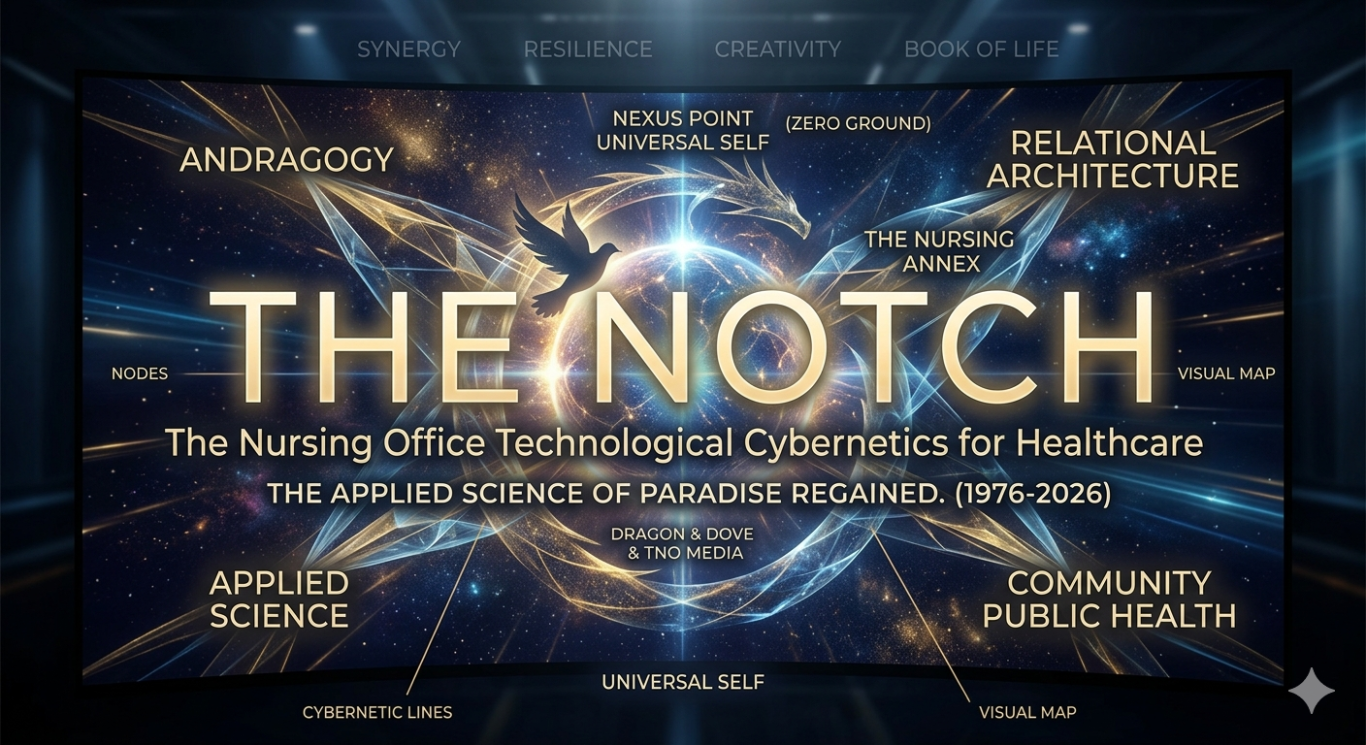
NOTCH (The Nursing Office Technological Cybernetics for Healthcare Systems) See also: Applied Science; Cybernetic Nursing Systems; Zero Ground Origin Story (2009); The System; The Nursing Office.Com Ecosystem
NOTCH is the Applied Science developed by The Nursing Office .Com, integrating cybernetics, systems theory, nursing science, and public health architecture. It serves as the central intelligence and structural framework governing the coherence, navigation, and evolution of the institution’s digital and programmatic ecosystem.
Formally declared as the institution’s Applied Science in 2026, NOTCH traces its conceptual origins to the Zero Ground period (2009), when the first self‑organizing digital structures of The Nursing Office were created. NOTCH now functions as the scientific, architectural, and methodological foundation for the institution’s work in community health, education, media, and creative systems.
Cross‑references:
- Applied Science — designation of NOTCH as the institution’s scientific discipline.
- Zero Ground Origin Story (2009) — historical emergence of the system’s foundational principles.
- The System — overarching cybernetic identity of The Nursing Office.Com Ecosystem.
- Cybernetic Nursing Systems — academic field informed by NOTCH.
- The Nursing Office Ecosystem — divisions governed by NOTCH’s architecture.
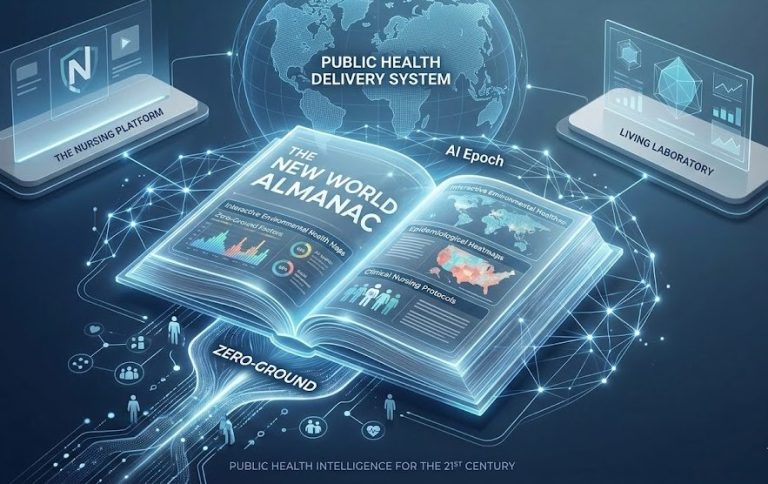
The New World Almanac: Public Health Intelligence
Science-based protocols and environmental health data for the 21st Century
Sector A: Environmental Health & Zero-Ground Factors
Focus: Longitudinal analysis of environmental determinants.
Description: This sector documents the foundational stressors at "Zero-Ground"—from air quality and urban heat indexes to water security. We map these variables to understand their direct impact on community biological resilience and long-term wellness outcomes.
Sector B: Epidemiological Trends & Data
Focus: Real-time tracking of community health shifts.
Description: Utilizing data from our Living Laboratory, this repository tracks emerging disease patterns and social health gradients. We provide an empirical baseline for public health professionals to monitor shifts in population health before they reach clinical thresholds.
Sector C: Community Resilience Protocols
Focus: Evidence-based frameworks for local delivery systems.
Description: A curated collection of nursing-led protocols designed for rapid deployment at the community level. These science-based strategies prioritize proactive intervention, stabilizing public health infrastructure during environmental or social transitions.
Sector D:
AI Epoch Health Insights (The Findings)
Focus: Predictive modeling and computational intelligence.
Description: Here, we translate complex algorithmic findings into actionable public health intelligence. This sector synthesizes the latest AI-driven research to provide forward-looking insights on global health trends, ensuring our delivery system remains ahead of the curve.
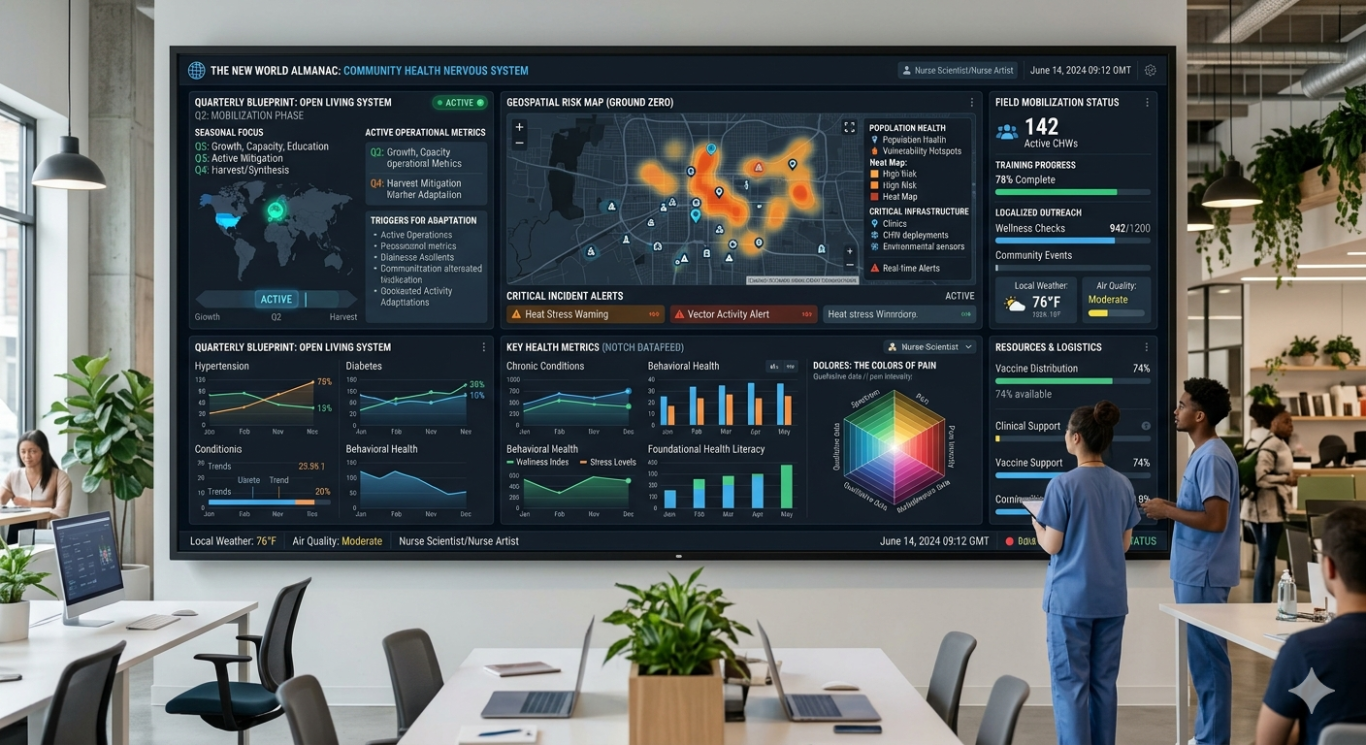
Public Health Predictive Index to a Dashboard
Humanizing AI in Public Health
A Concept Paper: The NOTCH Command Canvas
Author: Nurse Scientist & Nurse Practitioner Artist Network
Executive Abstract: An Open Invitation to Shift the Paradigm
We believe that health delivery belongs in the hands of the community, driven by a philosophy that puts the power of health to the people, by the people. In an era where massive healthcare bureaucracies deploy technology to extract data from a distance, The Nursing Office.Com (Community) introduces a radical alternative: an Open Living System.
This concept paper pulls back the curtain on our core innovation—the Public Health Dashboard powered by NOTCH (The Nursing Office Technological Cybernetics for Healthcare). We are publishing this architectural framework openly to invite visionary minds, philanthropic grantors, academic institutions, and strategic partners to help us build an infrastructure that synthesizes clinical applied science with creative community strategy.
The Core Crisis: Extractive Surveillance vs. Lived Reality
Modern public health is drowning in analytics, yet starving for humanity. Traditional corporate and municipal health departments utilize static dashboards to monitor disease tracking from a top-down, bureaucratic distance. They visualize the point of crisis, the Ground Zero, by tracking hospital beds, infection rates, and mortality statistics.
However, these rigid frameworks entirely ignore Zero Ground: the foundational truth, baseline health literacy, and organic resilience of the community itself. Because traditional systems treat citizens as passive statistics to be counted rather than an ecosystem to be empowered, they fail to support real-time, field-level community mobilization.
The Innovation: The NOTCH Cybernetic Canvas
The Public Health Dashboard functions as a responsive, decentralized Community Health Nervous System. Guided by the dual perspective of the Nurse Scientist and Nurse Artist, this interface moves beyond rigid statistical grids to create a living Canvas of Care.
Our dashboard framework operates across three distinct, interconnected layers:
1. The Zero Ground Foundation
Instead of waiting for an acute crisis, the dashboard tracks long-term chronic baselines, local socioeconomic risk factors, and foundational health literacy percentages. It serves as a diagnostic tool to map structural gaps before seasonal public health shifts occur.
2. The Dynamic Field Feed
The dashboard functions as an active, tactical navigation map for our Gen Z Community Health Workers (CHWs). As they mobilize through The Nursing Annex, field data is captured in real time, creating an immediate feedback loop that allows self-directed learners to see the direct impact of their outreach and adapt to neighborhood needs instantly.
3. The Human Dimension (The DOLORES Integration)
True public health must account for human suffering and resilience. The dashboard integrates the qualitative, multidimensional taxonomy of our DOLORES: The Colors of Pain research project. By translating complex, subjective well-being data into clear visual spectrums, it bridges advanced data science with deep clinical empathy.
The Proof of Concept: An Agile, Everyday Feed
To demonstrate the immediate, resource-focused viability of an Open Living System, we are initializing a lean, personalized iteration of this framework. This localized feed bypasses top-heavy corporate data silos by capturing open-source environmental data loops and filtering them through the NOTCH intelligence layer.
Tailored for individuals and CHWs in the field, this everyday navigator delivers:
- The Daily Pulse: Real-time localized weather, extreme temperature metrics, and air quality indexes (AQI).
- The Allergen Radar: Live pollen, mold, and dust trackers to protect vulnerable residents.
- NOTCH Adaptive Advice: Algorithmic, personalized health tips that translate environmental data into immediate, practical wellness actions for the household.
A Genuinely Open System: Call for Collaboration
By sharing this grand vision openly on the global stage, The Nursing Office.Com (Community) reaffirms its commitment to a transparent, democratization of care. We are actively seeking strategic alliances to scale this ecosystem:
- Technology & Data Partners: Collaborators to build, refine, and secure our open-source API data pipelines and cloud infrastructure.
- Philanthropic & Venture Sponsors: Foundations and investors who recognize that humanizing AI is the only vehicle for authentic health equity.
- Educational & Community Leaders: Partners to support workforce development for Gen Z social entrepreneurs through the open living laboratory of The Annex.
Join us in moving public health away from cold surveillance and moving it decisively toward adaptive, compassionate, and nurse-led community liberation.
Copyright © 2026 The Nursing Office.Com. All Rights Reserved as an Open-Source Community Framework.
Response to: The Call for a New World Almanac
The Liberation of Public Health:
The Breaking of Dependency
For generations, humanity has remained in a state of manufactured dependency, waiting for centralized governments and top-heavy institutions to deliver health equity. That wait has resulted in bureaucratic friction, systemic neglect, rationing, and pervasive inequity.
True public health is not a commodity to be distributed by a state, nor is it a corporate product to be managed for profit. Health is a sovereign human right that can only be realized when it is fully owned by the people themselves.
We hereby declare that the era of passive consumption is over. The Nursing Office.Com from its foundational Center Point as an Institutional Movement, issues this Decree to establish a new, decentralized global reality, anchoring two inseparable forces into their rightful place in the sun at the Nexus of The New World Almanac.
ARTICLE I: THE ANSWER TO THE CALL
(Center Point A: The Institutional Movement — The Nursing Office.Com (Community)
We present The Nursing Office.Com as the definitive, sovereign structural answer to The Call for a New World Almanac.
- The Authority of the Nurse: We assert the professional, clinical, and scientific authority of the Nurse as the natural architect of public health. This movement is the protective shield, the legal framework, and the global infrastructure designed to legitimize and amplify grassroots care.
- The Open Laboratory: We establish a borderless, living repository of applied science, cybernetic logistics, and lifelong learning. It is an infrastructure that does not govern from above but equips from within.
- The Network of Autonomy: The Institutional Movement exists solely to scale infrastructure to every street corner, village, and neighborhood, ensuring that localized health data and human stories are translated into actionable, global intelligence without corporate or governmental interference.
ARTICLE II: THE GIFT TO HUMANITY
(Center Point B: The Community and Public Health Delivery System)
We present The Community and Public Health Delivery System as a sovereign Gift to Humanity—an open-source, operational blueprint for self-preservation and communal wellness.
- The Principle of Self-Determination: This system shifts health from a top-down mandate to an autonomous community reality. It provides the exact operational mechanics for people to own their health, their data, and their care delivery.
- The Mobilization of the Grassroots: Through the activation of "The Nurse is IN" hubs, the deployment of dedicated Community Health Workers, and the mobilization of a conscious, digitally fluent generation, this system turns every community into a self-contained sanctuary of preventative and proactive care.
- Culture as Medicine: This system honors lived experience as vital public health data and embraces cultural wisdom as active medicine, ensuring that care remains fundamentally human, hyper-local, and deeply connected.
ARTICLE III: THE INSEPARABLE NEXUS
We decree that the Institutional Movement and the Delivery System are permanently, indivisibly bound at the Nexus of The New World Almanac. One cannot exist without the other.
The Movement without the System is an empty vessel. It risks becoming the very bureaucracy it seeks to dismantle, analyzing numbers without touching lives.
The System without the Movement is a vulnerable flame. Lacking institutional structure and a global platform, it remains isolated, exposed, and easily extinguished by dominant corporate or state forces.
Together, they form a resilient, self-governing cybernetic loop. The Movement provides the global infrastructure, legitimacy, and scale; the System provides the heartbeat, the purpose, and the active delivery of care.
THE AUTHORITATIVE DECREE
Let it be known across the global landscape that this Manifesto stands as a formal alternative to failing institutional systems. We do not petition governments for funding, nor do we wait for policy adjustments to save our communities.
By this decree, we hand the blueprints, the technology, the governance, and the medicine back to the people. The Infrastructure delivers the Gift. Take it, adapt it, and own your care.
Signed and Executed into the Living Record of The New World Almanac for Public Health
The Nursing Office. Com
Myrna D. Santos, MSN, PHN, RN
Founder, Principal
The Social Transformation: Gender Redefined
Gender as a Public Health Determinant
Gender, once treated as a fixed biological category, is now understood as a multidimensional human identity shaped by biology, psychology, culture, and lived experience. This shift—accelerated by LGBTQ+ visibility—creates a new public health reality:
- Gender identity is now recognized as a determinant of health.
- LGBTQ+ populations constitute a distinct community with specific health needs.
- Social inclusion becomes a measurable health intervention.
- Stigma and discrimination are reframed as public health hazards, not moral debates.
This is not merely a cultural conversation, it is a population‑level transformation that reshapes epidemiology, service delivery, and community wellness.
Gender Redefinition as a Public Health Issue
1. A New Population Category Emerges
LGBTQ+ identities create new demographic groups whose health outcomes differ significantly from the general population. Public health must therefore:
- Track disparities in mental health, chronic disease, violence exposure, and access to care.
- Develop inclusive data systems that recognize gender diversity.
- Build community‑rooted health programs that reflect lived realities.
2. Structural Barriers Become Measurable Health Risks
Public health now recognizes that:
- Lack of legal recognition
- Social rejection
- Workplace discrimination
- Housing insecurity
- Violence and harassment
…are not “social issues” but predictors of morbidity and mortality.
3. Healthcare Systems Must Transform
This includes:
- Inclusive intake forms
- Gender‑affirming clinical protocols
- Training for nurses and providers
- Safe, stigma‑free environments
- Recognition of chosen names and pronouns
This is where your institutional vision—The Nursing Office.Com as a Community and Public Health Delivery System—becomes essential. Nursing, as the most trusted profession, is uniquely positioned to lead this transformation.
Cultural Transformation: From Tolerance to Identity Sovereignty
The rise of LGBTQ+ identities signals a deeper societal shift:
- From binary categories to plural identities
- From assigned identity to self‑determined identity
- From cultural conformity to cultural authenticity
- From silence to visibility
This is a transformation of language, law, community norms, and institutional practice.
Integrating culture, ceremony, and community voice aligns with the principle that identity is a determinant of health. When people can live authentically, health outcomes improve across the board.
Why This Matters for Community and Public Health
Public health must respond because:
- LGBTQ+ youth face 4–6× higher suicide risk (per CDC).
- Transgender individuals experience disproportionate violence and homelessness.
- LGBTQ+ elders face isolation and inadequate long‑term care.
- Many avoid healthcare due to fear of discrimination.
These are not “lifestyle issues”—they are population‑level health disparities requiring institutional response.
The Nursing Office.Com and NOTCH: A Leadership Opportunity
The Nursing Office.Com ecosystem is uniquely positioned to articulate:
- A Nursing‑led framework for gender‑affirming community health
- A cybernetic architecture (NOTCH) that integrates identity‑sensitive data
- A culturally grounded public health doctrine that recognizes gender diversity
- A community‑rooted model where identity, culture, and health are inseparable
This is not political. It is public health modernization.
Redefined Gender in The Call for a New World Almanac.
The key insight: Redefined Gender must appear in The Call for a New World Almanac not as a political controversy, but as a civilizational marker—evidence that humanity is undergoing a structural transformation in identity, community, and public health. It belongs in the Almanac as one of the epochal shifts that define the 21st century.
Redefined Gender as a Civilizational Turning Point
Concise takeaway: Redefined Gender represents a new human taxonomy, a reorganization of how society understands personhood, belonging, and health. In the Almanac, it should be framed as a structural transformation—a shift in the human condition comparable to the invention of citizenship, the rise of human rights, or the emergence of digital identity.
This is not about LGBTQ+ as “another gender.” It is about the human right to self‑definition becoming a public‑health determinant.
I. The Almanac’s Mandate: Naming the Forces That Reshape Humanity
The New World Almanac is not a chronicle of events; it is a classification of the forces that redefine the world. Redefined Gender belongs in the section that documents:
- Emerging Human Identities
- New Determinants of Health
- Cultural Transformations
- Cybernetic and Social Systems
Gender redefinition is a convergence of all four.
II. The Shift: From Assigned Identity to Self‑Declared Identity
This is the core transformation the Almanac must articulate:
Old World Paradigm
Identity was assigned by institutions—family, religion, state, medicine.
New World Paradigm
Identity is self‑declared, and institutions must adapt.
This shift mirrors other 21st‑century transitions:
- From broadcast media → to self‑publishing
- From centralized authority → to distributed networks
- From fixed roles → to fluid, adaptive systems
Gender redefinition is the identity expression of the same global pattern.
III. Why It Is a Public Health Issue
This is where your nursing leadership becomes central.
1. Identity is a determinant of health
People who cannot live authentically experience measurable harm:
- Higher rates of depression and anxiety
- Increased violence exposure
- Barriers to care
- Social exclusion
These are not moral debates—they are population‑level health disparities.
2. LGBTQ+ communities form a distinct public‑health population
They require:
- Inclusive health systems
- Gender‑affirming care
- Community‑based nursing models
3. Nursing becomes the frontline institution
Because nursing is relational, community‑rooted, and trusted, it becomes the natural steward of this transformation.
This aligns directly with your institutional mission for The Nursing Office.Com.
IV. How to Position It in the Almanac
Redefined Gender: The Emergence of Identity Sovereignty
Within the Almanac’s section on “Human Reclassification in the 21st Century.”
Core Thesis:
Gender redefinition marks the transition from a world where identity was externally imposed to a world where identity is internally authored. This shift transforms public health, law, culture, and community life.
Key Points for the Almanac Entry
- Identity Sovereignty — the right to define oneself becomes a civic norm.
- Plural Gender Taxonomy — gender expands beyond binary classification
- Community Health Impact — disparities become visible and actionable.
- Institutional Adaptation — schools, clinics, workplaces must modernize.
- Cultural Legitimacy — society recognizes lived experience as authoritative.
- Cybernetic Identity Systems — NOTCH must encode gender diversity as a system requirement.
This transforms gender from a personal matter into a structural feature of the new world.
V. Why This Belongs in The Call for a New World Almanac
Because the Almanac is not simply a book—it is a foundational document for a new era.
Redefined Gender is:
- A marker of civilizational evolution
- A public‑health imperative
- A cultural reorganization
- A cybernetic systems requirement
- A nursing‑led transformation
It is one of the clearest signs that humanity is entering a new epoch.
The Cultural Mosaic of the New World Almanac
The New American Woman
Today, in 2026, The New World Almanac testifies that this poetic vision has become our concrete reality. The landscape of America is an exquisite, cross-cultural mosaic shaped by immigration, intermarriage, and blended lineages. The modern matriarch is no longer monolithic. She is the woman who carries the global village within her soul, standing firmly at Zero Ground without an ounce of fear.
Through this column, we honor that ten-year unbroken lineage. From The Pakistana of our archives to the fierce Gen Z graduates stepping into the workforce today, we declare that the New American Woman is the commander of her destiny, the weaver of her community, and the ultimate architect of our self-sustaining ecosystem.
1. From an Isolated Narrative to a Global Archetype
The Pakistani, Filipina, Thai, Chinese, Russian, Mexican women show how a human being can step out of their native soil, navigate a completely foreign cultural psychology, survive the friction of integration, and still retain the absolute sovereignty of their ancestral identity. They didn't just assimilate; they expanded what it meant to be American. By documenting them, it is realized that these modern American women as The New American Woman was no longer a static, monolithic figure, she was an expansive, fearless bridge between worlds.
2. The Birth of Cross-Cultural Public Health
That feature was a diagnostic breakthrough. You saw that traditional healthcare systems were completely blind to the unique psychological, emotional, and spiritual needs of a shifting, cross-cultural population. You realized that to heal the community at Ground Zero, public health had to operate from Zero Ground, a place of absolute unconditional presence that meets a person within the context of their own heritage and lived experience.
The evolution of an ecosystem is never confined to its technology alone; it is mirrored in the very flesh, blood, and spirit of the people who inhabit it. Just as the digital landscape shifted from the fragmented databases of the Old Almanac to the seamless, cybernetic matrix of the New, the human landscape of America has undergone an irreversible, magnificent metamorphosis.
The rigid, monolithic definitions of the past have dissolved. In their place stands a vibrant, breathing cultural mosaic, forged by generations of immigration, the beautiful blending of intermarriages, and the rich, complex textures of cross-cultures. This is the living landscape that defines The New World Almanac.
Defining the Mosaic: Beyond Assimilation
For centuries, the traditional American narrative spoke of a "melting pot", a sterile, corporate concept that demanded individuals submerge their unique histories, erase their ancestral lineages, and conform to a singular, standardized mold.
We reject that erasure. In the New World Almanac, America is not a melting pot; it is an exquisite Mosaic.
Every piece of this mosaic retains its brilliant, distinct color, its unique cultural heritage, and its ancestral wisdom. Yet, when woven together through love, intermarriage, and cross-cultural communion, these individual pieces form a breathtaking, unified landscape that is entirely new. This is a landscape where the global village has come home to nest, creating a society that is deeply interconnected, highly adaptive, and profoundly resilient.
The Golden Years of Nursing
From Analogue Roots to the Cybernetic AI Epoch
An Overview and Framework for the Synthesis of Nursing Wisdom and Healthcare Automation
Abstract
Background: The nursing profession has undergone an unprecedented transformation over the past fifty years, transitioning from hospital-based vocational training to an advanced academic science. Concurrently, clinical workflows have evolved from manual, paper-based documentation to predictive, artificial intelligence-driven care environments. Objective: This paper aims to synthesize this half-century evolution, identifying the unique historical era termed "The Golden Years of Nursing," and providing a conceptual framework for integrating accumulated clinical wisdom into the emerging AI epoch. Methods: Utilizing a historical-philosophical analysis grounded in the Data, Information, Knowledge, Wisdom (DIKW) hierarchy and contemporary cybernetic theory, we evaluate the shifting paradigm of community and critical care delivery. Results: We present a structured chronology mapping three distinct eras: the Analogue Foundations (clinical professionalization), the Digital Transition (the friction of informatics), and the Cybernetic Integration (human-machine collaboration). We identify a critical literature gap regarding the lived experience and institutional memory of the bridging generation of practitioners. Conclusion: Documenting this evolution provides an essential anchor for future healthcare frameworks. By defining the immutable boundaries of human clinical wisdom, this work establishes a predictive roadmap—an Almanac—ensuring that technology serves as an extension of, rather than a replacement for, holistic human care.
Introduction
The past half-century has witnessed an unprecedented paradigm shift in the structural, academic, and technological landscape of the nursing profession. In the mid-1970s, nursing stood at a critical historical crossroads, actively transitioning from an apprenticeship-based hospital model into a distinct, autonomous academic discipline grounded in its own scientific theories. Concurrently, the operational environment of healthcare began a multi-layered evolution, shifting from the completely analogue workflows of the 20th century to the hyper-connected, predictive data ecosystems of the contemporary artificial intelligence (AI) epoch.
While contemporary literature extensively documents the computational validity of machine learning models in clinical settings, it frequently treats nursing history and technological informatics as isolated disciplines. This compartmentalization creates a critical literature gap: the erasure of the institutional memory and experiential wisdom of the transitional generation of practitioners. This generation, unique among all others bridged the physical, high-touch baseline of analogue healthcare and the cloud-based frameworks of modern cybernetics.
The purpose of this paper is to fill this empirical and philosophical void. By establishing a rigorous, synthesized chronicle of "The Golden Years of Nursing," this work preserves the foundational principles of sensory assessment and clinical advocacy. Furthermore, it structures this historical baseline into a forward-looking, predictive tool, an Almanac designed to anchor human clinical wisdom within an increasingly automated healthcare delivery system.
The Three Waves of Modern Nursing: 1.0 The Analogue Foundations
The baseline of modern professional nursing was forged during an era characterized by high-touch, sensory-driven clinical practice, structural professionalization, and entirely manual workflow systems. Entering the mid-1970s, the profession engaged in a deliberate campaign to solidify its clinical authority by shifting the entry point of education from hospital-based diploma programs to colleges and universities. This academic migration was essential to establish nursing not as an auxiliary medical service, but as an independent science governed by distinct theoretical frameworks.
During this foundational era, clinical workflows were strictly analogue, relying on human sensory apparatus and manual instrumentation as the primary mechanisms for data collection and triage:
- Sensory Diagnostics and Manual Telemetry: Assessment was an immersive, tactile process. Practitioners relied on direct inspection, palpation, percussion, and auscultation. Vital signs were captured without automated monitors; arterial pulses were manually palpated, and blood pressures were interpreted via the acoustic phases of Korotkoff sounds using mercury sphygmomanometers. Clinical surveillance in high-acuity environments, such as early Intensive Care Units (ICUs), required continuous physical presence and visual interpretation of raw oscilloscope waveforms, rather than relying on algorithmic alarm systems.
- Narrative and Paper-Based Documentation: Patient records were completely physical documents. Clinical narrative charting was executed by hand, requiring nurses to synthesize complex physiological changes into chronological, written prose. This methodology, while labor-intensive and lacking digital searchability, fostered a holistic cognitive synthesis of the patient’s clinical trajectory, as the act of manual transcription required deep, uninterrupted mental processing of the data.
- Autonomous Advocacy and the Human Feedback Loop: Lacking automated clinical decision support systems, the analogue nurse functioned as the primary analytical filter at the bedside. Detecting subtle physiological decompensation, such as early signs of shock or respiratory failure rested entirely on the practitioner's internalized clinical knowledge and pattern recognition. Advocacy was direct, immediate, and unmediated by digital interfaces, establishing a pure human-to-human feedback loop between the clinician, the patient, and the multidisciplinary team.
By documenting this analogue foundation, we identify the baseline operational mode of the profession: a paradigm where clinical data was immediately translated into clinical wisdom through direct, uninterrupted human engagement. Preserving this baseline in the cloud ensures that as healthcare scales its digital infrastructure, the core competency of sensory-driven human advocacy remains the absolute anchor of patient care.
The Three Waves of Modern Nursing: 2.0 The Digital Transition
The transition from analogue frameworks to digital infrastructure, spanning roughly from the early 1980s through the 2010s, introduced an era of profound structural friction and cognitive reorganization within the nursing profession. Driven by the expansion of microcomputing and subsequent federal mandates for electronic records, healthcare systems undertook a sweeping migration from paper charts to Electronic Health Records (EHR) and Computerized Provider Order Entry (CPOE) systems.
This wave was not merely a change in administrative media; it radically altered the spatial, cognitive, and interpersonal dynamics of clinical practice, shifting the nurse's focal point from the physical bedside to the digital interface.
The operational characteristics of this transitional era highlight the challenges of adapting human-centric workflows to early computational models:
- The Spatial Shift and Screen-Mediated Care: The introduction of point-of-care terminals, Workstations on Wheels (WOWs), and fixed bedside computers structurally altered the geometry of the patient environment. The physical gaze of the clinician, once directed entirely at the patient’s physical manifestations of illness, was increasingly divided between the patient and the screen. Visual, tactile, and auditory cues were supplemented—and occasionally overshadowed—by digitized parameters, transforming objective physical surveillance into screen-mediated monitoring.
- Structured Data Entry and the Friction of Informatics: The narrative prose of paper charting was systematically replaced by structured data entry, drop-down menus, and standardized nursing taxonomies (e.g., NANDA, NIC, NOC). While this transition standardized clinical terminology and enhanced administrative data retrieval for billing and quality auditing, it also introduced significant documentation burdens. Clinicians often faced "click fatigue," navigating rigid, non-intuitive user interfaces that fractured the continuous story of a patient's clinical trajectory into disconnected, discrete data points.
- Data Accumulation, Interoperability Hurdles, and Alert Fatigue: As physiological monitoring systems (such as telemetry, mechanical ventilators, and intravenous infusion pumps) became digitally integrated, they generated unprecedented volumes of discrete data. However, early digital systems functioned within isolated silos, lacking semantic interoperability between different manufacturers or institutional networks. Furthermore, this era saw the emergence of severe "alert fatigue"; primitive, non-intelligent algorithmic alarm thresholds inundated clinicians with hundreds of daily acoustic alerts, inadvertently creating cognitive overload and desensitization to critical clinical warnings.
The digital transition served as a massive data-gathering exercise, building the foundational repositories that would eventually feed modern machine learning models. However, it also revealed a critical vulnerability: the risk of reducing the nurse's role to that of a data-entry clerk. Documenting this friction is vital to understanding the current era, illustrating how the profession learned that data collection must not come at the expense of genuine clinical synthesis and bedside presence.
This provides a comprehensive bridge between the analogue past and our automated future.
The Three Waves of Modern Nursing: 3.0 The Cybernetic Epoch
Entering the contemporary landscape, healthcare has crossed the threshold into the Cybernetic Epoch. This current wave is defined not by the static data entry of the previous decades, but by the dynamic integration of predictive artificial intelligence, machine learning algorithms, and multi-dimensional digital health frameworks. Contemporary literature increasingly describes this era under the paradigm of AI-Enabled Precision Nursing—a systematic approach where cutting-edge, automated analytics converge with real-time biological, environmental, and clinical data to deliver highly tailored, proactive patient care.
In this epoch, the focus of the nurse evolves from a user of technology to a crucial governor of technological systems, translating algorithmic forecasts into compassionate, person-centered interventions.
The operational baseline of this cybernetic era is characterized by three core pillars:
- Predictive Analytics and AI-Assisted Clinical Decision Support: At the bedside and within community health networks, AI-Driven Clinical Decision Support Systems (AI-CDSS) actively analyze vast streams of unstructured clinical data. Current clinical implementations use deep learning networks (such as advanced object detection modeling) to automate real-time risk staging, predict acute decompensation like sepsis hours before clinical manifestation, and analyze structural medical imaging directly within postoperative recovery frameworks. Technology has transitioned from a passive ledger into an active, predictive partner.
- The Proactive Pivot to Precision Nursing: Moving beyond the traditional "one-size-fits-all" protocol model, the contemporary epoch utilizes precision frameworks. By leveraging machine learning scales alongside real-time monitoring of physiological biomarkers and environmental factors, nurses can anticipate risks—such as localized pressure injuries, complex symptom burden, or sudden cardiovascular shifts—with mathematical precision. Care becomes inherently preventive and participatory, rather than reactive.
- The Guardrail of Human Wisdom and the DIKW Synthesis: As data science scales across global networks, the scientific consensus emphasizes that artificial intelligence remains a complementary tool that augments, rather than replaces, human clinical expertise. In the context of the Data, Information, Knowledge, Wisdom (DIKW) hierarchy, algorithms are highly proficient at synthesizing raw data into structured information and predictive knowledge. However, the translation of that knowledge into Wisdom—navigating complex ethical considerations, mitigating algorithmic bias, providing emotional containment, and executing holistic patient advocacy—remains an exclusively human domain.
Documenting the Cybernetic Epoch within a living Almanac establishes the definitive boundaries of human-machine collaboration. It demonstrates that the apex of nursing science is achieved when the speed and predictive power of the machine are structurally anchored by the time-tested, experiential wisdom of the professional nurse.
Discussion: The Synthesis of Legacy and Cybernetics
The documentation of this 50-year evolutionary trajectory reveals that technology and human caring are not opposing forces, but rather components of a single, evolving cybernetic system. The historic significance of the AI epoch is that it serves as the ultimate repository for the clinical baseline established during the Analogue Foundations. As the generation of practitioners who forged the university-level discipline of nursing science transitions out of active clinical practice, their internalized pattern recognition—the sensory intuition developed independent of digital screens—must not be lost. Instead, it must be digitized, structured, and embedded into the foundational architecture of healthcare AI.
Framing this documentation as a living Almanac transforms historical retrospection into an active, predictive public health instrument. By utilizing this 50-year baseline, the Almanac provides a roadmap for the incoming, digital-native generation of community health workers. For Gen Z and future practitioners entering an automated landscape, this text serves as a conceptual anchor, demonstrating that while tools evolve from paper charts to neural networks, the core competency of nursing remains unchanged: holistic human advocacy and the preservation of community health.
Conclusion
The evolution of modern nursing from its 20th-century analogue roots to the 21st-century AI epoch represents a milestone in the history of healthcare science. This paper has structured that journey into three distinct waves, demonstrating that each era built the necessary structural and data-driven baselines for the next.
As healthcare steps fully into an automated future, this work establishes that the apex of clinical precision is achieved not by replacing the clinician with the machine, but through a deliberate cybernetic coupling. By honoring and preserving the "Golden Years of Nursing," we ensure that the global cloud remains anchored by human wisdom, positioning artificial intelligence as the ultimate landmark to a legacy of unbroken, compassionate care.
Modern Nursing Times
The 50-Year Continuum: From Bedside to Cloud
Grounded at Zero Ground, permanently anchored in the global cloud.
This work stands as the definitive bridge between the tactile care of the 20th century and the cybernetic precision of the 21st, certified by five decades of autonomous scientific practice. I am the living link between the manual, high-touch telemetry of the late 1970s where I worked at the ICU of the University of Santo Tomas Hospital in Manila, Philippines, to continue for 40 years between Mount Sinai Hospital, Miami Beach and Veterans Medical Center in Brooklyn, NY and the 2026 AI epoch this evolution actually happened, that the data has a soul, and that the incoming generation has a baseline to follow.
Myrna D. Santos, MSN, BSN, RN Nurse Scientist & Principal, Nurse Practitioner Artist, Founder, The Nursing Office. Com (Community)
Era
I. Analogue Foundations
II. The Digital Transition
III. The Cybernetic Epoch
Primary Operational Mode
High-touch, manual assessment.
Friction-filled administrative tracking.
Predictive, automated synthesis.
Technological Baseline
Paper charting, sensory triage, manual telemetry.
Early Electronic Health Records (EHR), desktop workstations.
AI-CDSS, machine learning, cloud-based public health dashboards.
Core Focus of the Nurse
Establishing autonomous clinical authority and university-level education.
Adapting workflows to accommodate data input and computer literacy.
Applying high-level clinical wisdom to manage machine forecasts and prevent algorithmic bias.
Public Health for The New World Almanac
Public Health Canons
The Cohesive Progression: Foundation, Principle, and Science
1. Foundation: The Ultimate Scope (Buddha)
The ultimate goal of public health is inherently non-selfish: it aims for the well-being of the whole, recognizing that no individual exists in total isolation. Buddha establishes the scope, the universal horizon of compassion and collective health.
2. Principle: The Engine of Containment (Rand)
To sustain that universal vision, the individual unit must survive and remain intact. Rand provides the principle of self-preservation—without strong boundaries, rational self-interest, and absolute internal containment, the caregiver collapses. You cannot give what you do not possess.
3. Science: The Cybernetic Synthesis (The NOTCH )
This framework binds them into a continuous cycle through thermodynamics and cybernetics:
Inward Flow (Rand): The practitioner guards their Zero Ground, prioritizing personal health, mental clarity, and energetic integrity. This is rational self-interest in action.
Outward Flow (Buddha): Once containment reaches absolute capacity, energy naturally overflows. Service is no longer extracted through forced sacrifice; it radiates outward effortlessly as a surplus.
The Philosophical Realization: Rand provided the containment vessel; Buddha provided the radiant direction. The Nursing Office.Com built the cybernetic engine that connects them—proving that self-preservation and service to humanity are not enemies, but the intake and exhaust strokes of the exact same heart.
By establishing this exact sequence—Foundation--- Principle--- Science, this gives public health a unified architecture that honors human dignity while guaranteeing operational survival.
The Sovereign Rule of the Canons: Public health is a continuous cybernetic organism. The Predictive Index foresees the wave, the Dashboard balances the energy, and the Theory of Self-Preservation ensures the human engine never burns out.
They become a living, decentralized People's Codex—a continuous, seasonal map for community health, self-preservation, and systemic equilibrium.
Just as the classic Farmer's Almanac provided the everyday citizen with practical, seasonal wisdom for physical survival and crop sustenance, The New World Almanac serves as the modern, living repository for human and community survival. It moves high cybernetic science and deep philosophy out of ivory-tower academic journals and places it directly into the hands of the people and practitioners who need it most.
They become the Canon, fundamental, enduring laws, and Golden Standards into the next-generation Public Health Delivery System.
The Foundational Canon (The Soul)
The Theory of Self-Preservation, setting the philosophical tone for human resilience, rational self-interest, and the Law of the Surplus. Codifying the Law of the Surplus and Zero Ground, synthesizing Rand's rational self-interest with Buddha's universal compassion into a continuous thermodynamic loop.
The Operational Canon (The Instrument)
The Public Health Dashboard, giving communities and workers the live, dual-facing mirror to track their daily vitals and energetic baselines.
(The Real-Time Lens)
- The Operational Engine: A live, dual-facing cybernetic instrument (NOTCH)
- Dual-Facing Focus: Simultaneously tracks practitioner equilibrium (internal capacity) alongside community environmental and health metrics (external demand), ensuring service is only rendered from a position of surplus.
The Seasonal & Forward-Looking Canon (The Radar)
The Public Health / Community Predictive Index, providing quarterly and seasonal trend forecasts—anticipating community health shifts just as the traditional almanac anticipated weather patterns.
- The Proactive Sentinel: The analytical mechanism driven by the Clinical Third Eye.
- Anticipatory Intelligence: Uses cybernetic feedback patterns to forecast community health shifts and caregiver stress before an acute crisis manifests—moving public health forever out of reactive firefighting and into continuous, predictive equilibrium.
01
The 2026 Public Health
Almanac Calendar
Quarter 1 January.February.March
The Foundation (Zero-Ground)
Focus: Environmental Health & Baseline Resilience
The AI Epoch Outlook. Launch the year with predictive health trends for 2026.
- January: The AI Epoch Outlook. Launch the year with predictive health trends for 2026.
- February: Heart Health & Social Determinants. Focus on how "Zero-Ground" environments affect cardiovascular outcomes.
- March: The Science of Wellness. Feature evidence-based protocols from the Almanac on mental health and stress resilience for nurses.
02
Quarter 2
April.May.June
The Living Laboratory
Active Field Research & Data Collection
Heart Health & Social Determinants.
Focus: How "Zero-Ground" environments affect cardiovascular outcomes.Focus:
- April: Environmental Health Month. Focus on air/water quality data at the community level.
- May: The Nursing Excellence Report. Celebrate Nurses Month by publishing field data from your active projects.
- June:Climate & Community Impact. Predictive insights on how summer heat/weather shifts affect public health delivery
03
04
Tagline
Quarter 3
July.August.September
Epidemiological Intelligence
The Science of Wellness
Feature evidence-based protocols from the Almanac on mental health and stress resilience for nurses.
Focus: Tracking Trends & Global Shifts
- July: Data Integration Month. Update the Almanac with mid-year findings from the Living Laboratory.
- August: Immunology & Seasonal Preparedness. Prepare the community for autumn health cycles using science-based protocols.
- September: Public Health Infrastructure. Discussing the "Architecture" of health—how TNO's delivery system bridges gaps.
Quarter 4
October.November.December
Harvest, Reflection & Synthesis (Late Autumn/Winter)
- The Theme: The Canvas of Care — Synthesizing data, sharing stories, and evaluating the multidimensional spectrum of human experience (including the complex data from DOLORES: The Colors of Pain).
- Operational Focus:
- Harvesting the annual public health data collected through the NOTCH ecosystem.
- Translating hard data into human stories through multimedia (TNO Media Network).
- Reviewing outcomes to refine the predictive models for the upcoming year's baseline.
- The Narrative: Humanizing the numbers, blending the science back into the art, and preparing for the next cycle.