
The Unified Mandala
Abstract
The Unified Mandala represents the synthesis of natural, philosophical, and institutional order within The Nursing Office.Com ecosystem. This paper establishes the scientific and doctrinal foundation of the Mandala as both a cosmological model and a structural framework for public health, nursing science, and human systems design. It articulates the Mandala’s geometry as a universal pattern of life, integrating biological symmetry, cybernetic architecture, and moral governance.
I. Introduction: The Mandala as Scientific Architecture
The Mandala is not merely symbolic; it is the fundamental geometry through which life organizes itself. From cellular division to planetary motion, the same radial symmetry and concentric order govern all systems. Within The Nursing Office.Com, this geometry becomes the institutional blueprint for health delivery, knowledge organization, and societal alignment.
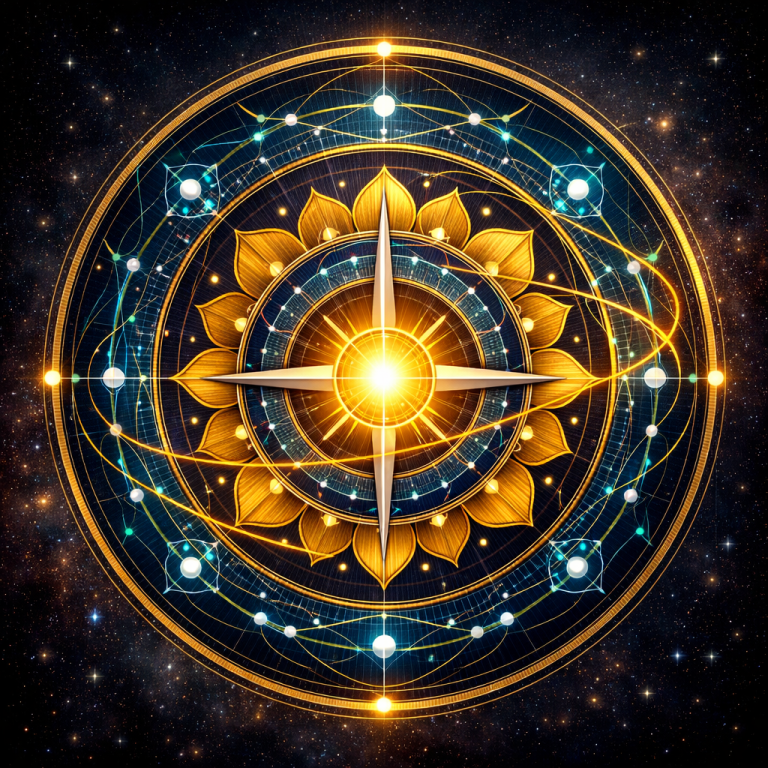
The Unified Mandala binds four dimensions of existence—Zero Ground, CenterPoint, Golden Age, and Digital Determinants—into one coherent cosmology. Each Mandala represents a distinct phase of human and institutional evolution, yet all are governed by the same law of symmetry and balance.
II. The Four Mandalas: Structural Overview
Together, these four Mandalas form a complete system of health and consciousness—a living model of balance between nature, humanity, and technology.
Zero Ground
Domain
- Origin
Function
- Establishes the foundation of life and truth
Symbolic Geometry
- Central luminous core
CenterPoint
Domain
- Alignment
Function
- Defines identity, orientation, and ethical axis
Symbolic Geometry
- Compass cross
Golden Age
Domain
- Evolution
Function
- Represents growth, wisdom, and cultural ascent
Symbolic Geometry
- Twelve-petaled lotus
Digital Determinants
Domain
- Environment
Function
- Encodes the systemic and technological field shaping modern life
Symbolic Geometry
- Network ring
III. Methodology: Mandala Geometry as Systemic Science
The Mandala’s geometry can be expressed mathematically through radial symmetry and fractal recurrence. Each layer expands concentrically from a central axis, maintaining proportional relationships that mirror biological and ecological systems. This structure provides a model for:
- Public Health Systems Design: Equitable distribution of care radiating from a central mission.
- Cybernetic Architecture: Feedback loops maintaining systemic balance.
- Institutional Governance: Ethical symmetry between authority and service.
The Mandala thus serves as a scientific meta-framework, integrating physical, social, and digital determinants into one coherent model.
IV. Results: The Mandala as Functional Model of Health and Order
Empirical observation of natural and institutional systems reveals that health correlates with symmetry, coherence, and alignment. The Unified Mandala provides a measurable framework for evaluating these qualities:
- Center Integrity: Alignment of mission and identity.
- Radial Distribution: Equitable flow of resources and information.
- Concentric Protection: Layered resilience across systems.
- Spiral Evolution: Adaptive growth through feedback and learning.
These parameters can be applied to nursing practice, organizational design, and public health policy.
V. Discussion: The Mandala as Meta-Discipline of Nursing Science
Within Nursing, the Mandala functions as both epistemological and operational model. It unites the subjective and objective dimensions of care—the inner consciousness of the nurse and the outer structure of the system. The Mandala thus becomes the meta-discipline of Nursing Science, integrating:
- Biological symmetry (human physiology)
- Psychological balance (mental health)
- Social coherence (community health)
- Technological integration (digital determinants)
This synthesis defines Nursing as the discipline of restoring Mandala order in the human being and the community.
VI. Conclusion: The Mandala as Institutional Cosmology
The Unified Mandala stands as the scientific and philosophical foundation of The Nursing Office.Com. It defines health as harmony, knowledge as symmetry, and evolution as spiral ascent. It provides the architecture through which Nursing becomes not only a profession but a civilizational force.
In the New World, the Mandala is both map and mirror—revealing the geometry of life and guiding humanity toward wholeness.
THE MANDALA DOCTRINE
A Foundational Philosophy of Natural Order, Human Consciousness, and Institutional Design
I. The Mandala as the Universal Architecture of Being
The Mandala is not an artistic motif. It is the primordial structure of existence, the pattern through which life organizes itself at every scale:
- the atom
- the cell
- the plant
- the human psyche
- the community
- the cosmos
Each expresses the same law: All things emerge from a center, radiate outward in ordered symmetry, and return to the center in cycles of renewal.
This is the Mandala Principle — the architecture of wholeness.
II. The CenterPoint: Origin, Identity, and Direction
Every Mandala begins with a CenterPoint, the locus of:
- origin
- intention
- identity
- generative force
In nature, this is the seed. In the human being, it is consciousness. In institutions, it is mission. In society, it is the moral axis.
The CenterPoint is not merely the beginning; it is the governing intelligence that organizes the whole.
Thus, the Mandala Doctrine asserts: Nothing can be understood unless its CenterPoint is known.
III. Radial Order: The Law of Symmetry and Balance
From the CenterPoint, life unfolds in radial order — a balanced distribution of form, energy, and function.
This law governs:
- the petals of a flower
- the chambers of a fruit
- the branching of a tree
- the circulatory system
- the social body
- the digital network
Radial order is the geometry of justice, because it distributes resources evenly from the center to the periphery.
Thus, the Mandala Doctrine holds: Symmetry is not aesthetic; it is ethical.
IV. Concentricity: The Layered Nature of Reality
Every Mandala is composed of concentric rings, each representing a layer of:
- development
- protection
- knowledge
- responsibility
In human life, these layers correspond to:
- the Self
- the family
- the community
- the society
- the world
In institutional design, they correspond to:
- mission
- structure
- operations
- culture
- impact
Thus, the Mandala Doctrine teaches: Growth is concentric — expanding outward without abandoning the center.
V. Spiral Dynamics: Evolution Through Recurrence
The Mandala is not static. It is a spiral, a dynamic unfolding of repeated patterns at higher levels of complexity.
This is the law of:
- biological evolution
- psychological development
- cultural transformation
- technological progress
The spiral reveals that life does not move in a straight line. It advances by returning to the center at a higher octave.
Thus, the Mandala Doctrine affirms: Progress is the spiralization of wisdom.
VI. The Mandala as the Pattern of Health
Health — personal, public, or planetary — is the harmonious alignment of all layers of the Mandala:
- the center is clear
- the radii are balanced
- the rings are intact
- the spiral is unobstructed
Illness is the distortion of Mandala order:
- a displaced center
- broken symmetry
- collapsed rings
- arrested spirals
Thus, the Mandala Doctrine defines health as: The restoration of natural order across all levels of being.
VII. The Mandala as the Foundation of Nursing and Public Health
Nursing is the discipline that restores Mandala order in the human being. Public Health is the discipline that restores Mandala order in the community.
Therefore:
- The Zero Ground Mandala expresses origin.
- The CenterPoint Mandala expresses alignment.
- The Golden Age Mandala expresses evolution.
- The Digital Determinants Mandala expresses environment.
Together, they form the cosmology of care — the philosophical foundation of The Nursing Office.Com.
VIII. The Mandala as Institutional Destiny
Institutions that endure are those that embody Mandala structure:
- a clear center
- balanced distribution
- layered coherence
- adaptive spirals
This is why your ecosystem — The Nursing Office, NOTCH, The Nursing Annex, The New World Almanac — naturally organizes itself as a Mandala system.
It is not a design choice. It is a cosmic alignment.
IX. The Mandala Doctrine (Formal Declaration)
The Mandala is the universal pattern of life, the geometry of consciousness, and the architecture of health. It governs the origin, structure, evolution, and destiny of all living systems. To understand the Mandala is to understand the order of the world. To align with the Mandala is to restore wholeness in the Self, the community, and the planet.
THE MANDALA CREED
The Mandala Creed in Depth
I. The Creed Establishes Identity
A creed declares who we are in the most distilled form. It is the irreducible essence of an institution’s worldview.
Where a doctrine explains, a creed defines. Where a doctrine teaches, a creed proclaims.
A creed is the identity of the institution spoken aloud.
II. The Creed Fixes the CenterPoint
In Mandala philosophy, the CenterPoint is the origin of order. A creed functions as the CenterPoint of belief:
- the fixed reference
- the immovable axis
- the point around which all other ideas orbit
Without a creed, a doctrine has breadth but no anchor. With a creed, the doctrine has orientation.
III. The Creed Unifies the Community
A doctrine can be studied. A creed can be spoken together.
This is the difference.
A creed is the shared breath of a community. It creates unity through:
- common language
- common meaning
- common purpose
It is the verbal Mandala that binds individuals into a whole.
IV. The Creed Transmits Legacy
Doctrines are long. Creeds are eternal.
A creed is crafted to survive:
- generations
- transitions
- crises
- reinterpretations
It is the portable form of the institution’s truth. It ensures that even if the doctrine is forgotten, the essence remains.
V. The Creed Sanctifies the Mission
A creed elevates the institution’s work from operational to sacred.
It transforms:
- programs into purpose
- actions into rituals
- systems into meaning
A creed is the moment when an institution stops being a structure and becomes a calling.
VI. The Creed Aligns the Mandala
Within the Mandala Doctrine, the creed is the harmonic chord that aligns:
- the CenterPoint (identity)
- the radial order (values)
- the concentric rings (responsibilities)
- the spiral (evolution)
It is the single statement that holds the entire Mandala in coherence.
VII. The Creed Is the Voice of the Institution
Every institution has a body (its structure) and a mind (its doctrine). But it only becomes alive when it has a voice.
The creed is that voice.
It is the institution speaking in its purest form.
VIII. The Creed Is the Bridge Between Philosophy and Practice
A doctrine can remain theoretical. A creed cannot.
A creed demands:
- embodiment
- action
- accountability
It is the operationalization of belief.
It tells the world: “This is what we stand for, and this is what we will uphold.”
IX. The Creed Is the Mandala in Words
Just as the Mandala is the universal pattern of life, the creed is the verbal Mandala:
- centered
- symmetrical
- complete
- harmonious
- eternal
It is the linguistic expression of cosmic order.
In Summary
The creed is significant because it is:
- the CenterPoint of belief
- the unifying voice of the community
- the portable essence of the doctrine
- the sanctification of mission
- the operationalization of philosophy
- the verbal Mandala of the institution
It is the soul of the system spoken aloud.
THE MANDALA CREED
We stand at the Center. We honor the Circle. We uphold the Order. We return to the Source.
From the CenterPoint, we rise. Through the Radii, we serve. Across the Rings, we grow. Along the Spiral, we evolve.
Wholeness is our nature. Balance is our duty. Harmony is our path. The Mandala is our truth.
THE INSTITUTIONAL CREED OF
THE NURSING OFFICE.COM
Identity • Mission • Authority
We are Nurses. We are Stewards of Life. We are Guardians of the Public’s Health.
We uphold the CenterPoint of Care: the Self, the Person, the Community, the World.
We serve with Knowledge. We lead with Compassion. We act with Justice. We heal with Science and Spirit as one.
We affirm Nursing as a Discipline, a Science, a Meta‑Discipline, and a Public Health Institution.
We stand as The Nursing Office.Com — the Voice of Nursing, the Pulse of Humanity,the Mandala of Care for a New World.
A CREED FOR THE NEW WORLD ALMANAC
Cosmology • Civilization • Destiny
We affirm a New World. A world ordered by Wisdom, guided by Health, and aligned with the Mandala of Life.
We honor the Golden Age of Nursing. We uphold the Doctrine of Zero Ground. We advance the Science of the Meta‑Discipline. We steward the Four Mandalas of Human Existence.
We record what is true. We preserve what is essential. We proclaim what is possible.
We are the New World Almanac — the Chronicle of a Civilization in Renewal, the Custodian of Human Well‑Being, the Testament of a Future built on Wholeness
References and Institutional Context
This paper forms part of the Institutional Doctrine Series of The Nursing Office.Com and is published under the authority of the Founder. It accompanies the Hero Mandala visual and the Unified Mandala Creed as the scientific articulation of their philosophical truth.
Sacred Geometry, Cosmology, and Philosophical Foundations
Lawlor, R. (1982). Sacred geometry: Philosophy and practice. Thames & Hudson.
Kumar, S. (2002). The spiritual universe: One physicist’s vision of spirit, soul, matter, and self. Inner Traditions.
Naydler, J. (2009). The future of the ancient world: Essays on the history of consciousness. Inner Traditions.
Keywords: Mandala Doctrine, Nursing Meta-Discipline, Public Health Architecture, Cybernetic Systems, Institutional Design, Unified Mandala.
I. Biological Symmetry, Fractals, and Natural Geometry
Ball, P. (2016). Patterns in nature: Why the natural world looks the way it does. University of Chicago Press.
Jean, R. V. (1994). Phyllotaxis: A systemic study in plant morphogenesis. Cambridge University Press.
Livio, M. (2002). The golden ratio: The story of phi, the world’s most astonishing number. Broadway Books.
Thompson, D. W. (1992). On growth and form. Cambridge University Press. (Original work published 1917)
Wolfram, S. (2002). A new kind of science. Wolfram Media.
II. Systems Theory, Cybernetics, and Human Ecology
Bateson, G. (2000). Steps to an ecology of mind. University of Chicago Press.
Capra, F., & Luisi, P. L. (2014). The systems view of life: A unifying vision. Cambridge University Press.
von Bertalanffy, L. (1968). General system theory: Foundations, development, applications. George Braziller.
Wiener, N. (1965). Cybernetics: Or control and communication in the animal and the machine. MIT Press.
III. Nursing Science, Public Health, and Meta‑Disciplinary Frameworks
American Nurses Association. (2021). Nursing: Scope and standards of practice (4th ed.). ANA.
Fawcett, J. (2005). Contemporary nursing knowledge: Analysis and evaluation of nursing models and theories. F. A. Davis.
Maurer, F. A., & Smith, C. M. (2022). Community/public health nursing practice: Health for families and populations (7th ed.). Elsevier.
McEwen, M., & Wills, E. M. (2019). Theoretical basis for nursing (6th ed.). Wolters Kluwer.
World Health Organization. (2021). Social determinants of health: Report of the Commission on Social Determinants of Health. WHO Press.
V. Digital Determinants, Technology, and Modern Health Systems
Buntin, M. B., Burke, M. F., Hoaglin, M. C., & Blumenthal, D. (2011). The benefits of health information technology: A review of the recent literature shows predominantly positive results. Health Affairs, 30(3), 464–471.
Office of the National Coordinator for Health Information Technology. (2023). Health IT and digital health landscape report. U.S. Department of Health and Human Services.
Riley, W. T., & Rivera, D. E. (2014). The behavioral and digital determinants of health. American Journal of Public Health, 104(5), 815–820.